Saturday, May 25, 2013

Independence Day, New York Time May 25th, 1946

Trans-Jordan Emir Becomes King in Setting of Arabian Pageantry


By Gene Currivan

Amman, Trans-Jordan, May 25- The emirate of Trans-Jordan became a kingdom today and Emir Abdullah became King Abdullah Ibn Ul-Hussein in a spectacular ceremony and amid a setting that in some respects resembled a frontier town in the Western United States when the first railroad came through.

Amman was jammed. Dignitaries from all the surrounding countries were on hand to pay their respects to the world's newest king. The narrow bazaar-lined streets were flag-bedecked and crowded with colorfully garbed Arabs.

Crowns decorated the festooned and illuminated archways and ever present were photographs of the 64-year-old monarch who some day hopes to rule a kingdom that will some day include Syria, Lebanon and Iraq.

Suring his acceptance speech at the palace, King Abdullah intimate as much when, after thanking and his loyal subjects for his good fortune, said:

"My hope is that soon there will be a federation, effective and powerful, of all Arab states. I offer my throne as a rallying point for that federation."

His remarks also were constructed to mean a federation of Arab states to meet the threat of Jewish encroachment, because he later added that "Palestine is a special case and will be given special treatment."

His speech occupied a few minutes of the fourteen-minute ceremony in the throne room where the dignity of the setting received a bit of a setback as the klieg lights flooding the dais for the battery of cameraman gave the scene a Hollywood flavor.

The King, wearing a black flowing robe, with a gold chain hanging from his neck and a halo-like agal or camel hair rope holding his headdress in place, read his speech and never changed expression. He was flanked by his two sons, his Ministers and on either side of the room were the British delegation and visiting statesmen.

After the palace ceremony all converged on the Royal Air Force field for the biggest show of the day- the King's review of the fabulous Arab Legion.

The reviewing stand was flanked by Arab Legion bands- pipes on one side and brass on the other. Lined up across the field were colorful units of the legion, including a camel corps and cavalry nd a mechanized brigade of infantry and artillery.

Glubb Pasha on Hand

With the King was Glubb Pasha (Brigadier John B. Glubb), the glamorous figure who helped organize the legion, mostly from desert Bedouins- who now prevent other Bedouins from becoming unruly. He wore a British summer uniform and spiked helmet and at hi side was a long sword.

Each unit paraded counter-clockwise across the field, passed the reviewing stand and then formed in front of it and marched in parade review directly toward the King. No monarch could have asked for more than this precision march of one of the world's most colorful armies.

Beyond the tented areas tribes raced around on their spirited mounts, firing their pistols in the air and otherwise adding an Arab rodeo effect to the scene. down in the town others who could no longer restrain their emotions fired from second floor café windows fired as cars bearing the guests went by.

Thursday, May 23, 2013

Iraqi Gets Beaten, Just Because

I was so pleased to see those brave Jordanians (in the clip below) beating the shit out of this Iraqi employee at the embassy. I was also pleased to see a brave Jordanian writer express his desire to shoot those non-Jordanians who can't drive or behave well, especially while they're talking with their funny accent in the street. They come to our country and they expect to be treated like they're equal? They come to our house and start making their own rules?

I liked all the Iraqi-hating Syrian-cursing Egyptian-condescending comments, clips, pictures and articles on facebook on my way back from work. If you're wondering where I work, it's in the United States. I moved here about 10 years ago alongside many of my classmates, not because there was a war in my country and I had to flee so I won't be slaughtered like a goat, I just moved here because there's a better opportunity to make money and be treated well. I don't only have a different accent, I speak a different language, have a different culture, and still have deep connections home. When I want to complain about problems here, I don't do it behind closed doors, I do it in front of people, write about it in the paper or express it on TV. Americans don't beat the shit out of me when I diss their country, instead they gave me a green card. Even in a country that sets the bar for freedom so high that one can burn the flag of his country in the street, no journalist is allowed to write an article encouraging violence against a certain group of people. He can go to jail for that.

But they're cowards, and we are brave. We can beat people because we can. They don't know what they're missing. I just hope, from the bottom of my heat, as an Arab, that Americans will start judging an entire ethnicity of millions of people just based on the action of a very small minority. Only then will I realize they have been promoted to become a third world country and I will finally feel that I belong here.
(Warning: clip consists entirely of foul language)
 

Monday, September 10, 2012

Suicide in Jordan


As The Abdoun Bridge was being constructed, many equated it with giant bridges in the West, such as the Golden Gate bridge in San Francisco. It was the country's biggest, the most efficient, connecting parts of the big city that were far apart, and a masterpiece of design that improved the view of the cramped environment. And just like the Golden Gate Bridge, it was where young people went to kill themselves. Recently they found another one, a 27-year old man underneath the bridge. In 2010 they found another guy. Others try. Women too. Suicides also occurred in 2010.

In the 1980s, I remember reading the Guinness World Records books, and Jordan used to be mentioned only once.  It was in the suicide section. We had the lowest rates of suicides in the world with only one reported case in the history. Even as a child then I could tell this was a lie, because I had personally known of two Jordanians who had killed themselves years before: Author Tayseer Al-Sboul in 1973 and my mother's neighbor in Salt who threw herself off the balcony when Abdil Haleem Hafiz unexpectedly died in 1977. We had a problem then that we still have now: we under-report numbers that may indicate that our nation, God forbid, may have problems, especially when it comes to suicide.

Since we like comparing our bridges to the West, let's see what the West does when it comes to suicides. First, they admit they have a major problem with it. They analyze why do people kill themselves. They try to prevent it. For example, they found out that kids being bullied in schools have a much higher risk of committing suicide. They now have fierce anti-bullying campaigns in schools. They found out that military personnel tend to have very high rates as well, so they expanded programs allowing for soldiers to receive psychiatric consultations (maybe a better strategy would be: don't start more wars?). They still have a big problem with it, but at least they acknowledge it.

For every person who kills himself, there are many others who want to but failed or still didn't have the plan or energy to do it, but they will one day.

What can you we do as Jordanians?

First, don't say it's not your problem. There are people around you who are depressed who the thought of suicide came across their minds one day. Start with stressed out Tawjihi students and end up with wrist-slashing unmarried women in their 40s. Rarely ever will someone tell you "I'm depressed". But you'll be a fool not to note it with every conversation you have with them.

Secondly, don't make it a crime to see a psychiatrist or a counselor. If you have never felt too stressed in your life to the point of breaking down, then you haven't done anything challenging in your life. People react differently to stress. Even those who are able to handle it well have learned how to do it after some tough times.

Third, don't tell people it's their fault that they're depressed. Don't blame their parents or their siblings. Plenty of Jordanians suffer from pathological depression and they're not being treated. Being depressed doesn't mean you're less religious or that your family doesn't care about you. Sometimes, people just get "messed up" in the head. They can be very poor or very rich. They can be men or women. They can be the most sophisticated guy you know or a simple-minded person who can't form a single thought in his head.

Jordan is going through tough times, and many people in it have seen a lot of horrendous struggles in the past few years from the Iraq war to the overwhelming Israeli aggression to the mass murders in Syria. Even in Jordan there are more kids being born whose future is unlikely to be bright. We will have more people than ever who will think of life as not being worth living. It's not their fault , but it's your fault if not only you fail to reach out, but also deny their existence.


Wednesday, November 16, 2011

King Abdullah Just Said This


King Abdullah suggested today, very clearly, that Bashar Al-Assad should step down.

This is huge, unprecedented, and surprising, for two reasons, two very good reasons, in my opinion.

ONE
Correct if I'm wrong, but this is the first time a Jordanian king ever asks for any other leader to step down, let alone be an Arab leader, let lone be it the Syrian leader. Late King Hussein had hoped for many Arab leaders to vanish , in Syria, Iraq, Egypt, Saudi Arabia, Algeria, Palestine...etc. These were not only posing a threat to the monarchy, but to the stability of Jordan itself. But he never went public, for several reasons, in claiming that these regimes had to go. He supported the Islamic opposition to Hafiz Assad but he didn't claim Assad must go for the better of the Syrian people.

So today, things changed. We have finally asked the leader of a "brotherly" country to step down.

TWO
if you read exactly what his majesty said about Syria,

"If it was me, I would step down and make sure whoever comes behind me has the ability to change the status quo that we're seeing,"

He said, "I would step down if......"

Correct me again if I'm wrong, but I don't think any Jordanian king has ever said "I would step down " for whatever reason. Never. I haven't heard every single speech or read every public letter for all the Jordanian monarchs, but I don't think such language was ever used before.

Certainly Jordan is not like Syria. People are not being killed in the streets and many of the most angry and the dissatisfied Jordanians are not calling for the King to step down. King Hussein faced heavier opposition with crowds screaming in the streets in many Jordanians cities for him to be removed during several rough times in the past, but he had never mentioned that he would step down if something happened.
----------------------

Since its independence, King Hussein struggled to prove that he's a true Arab leader who was ready to lead an underdeveloped nation into security and prosperity and prove that it had many good reasonable for existence even when the entire world had many doubts about it. I think that to a great extent he was able to accomplish this. He tried to avoid any kind of confrontation and always took the side of neutrality unless his throne or the the future of the country were be in jeopardy.

The statement from his majesty today, in my opinion, reflects a major shift in our attitude toward the world.
We didn't have to stand against the Syrian regime regardless of how brutal it was. But King Abdullah felt it was necessary for him to be the first Arab leader to make that statement. We all know that Syria has threatened to invade Jordan and in fact did invade Jordan more than any other country besides Israel. For Jordan to take that strong position against Syria, there might be a big a price to pay, but I hope that our moral obligation towards taking the stand is completely worth it.

Wednesday, November 09, 2011

Ronald Reagan vs. King Hussein

Ronald Reagan was the US president between 1981 to 1989. After the end of his term, in 1994, he announced that he was diagnosed with Alzheimer's Disease. However there were some signs suggestive that he had some "concentration issues" , to say the least, while he was still in office. One of these incidents occurred during a meeting with King Hussein.

Richard Viets, the US ambassador to Jordan in 1981, gave an interview reporting a very interesting meeting between the two leaders. Avi Shleim reports:

"On that first visit the Reagans invited the king and Queen Noor to lunch in their private quarters. Viets was also invited. In the middle of this small affair, Reagan suddenly said, "I understand that the Dead Sea is so salty that no fish can survive in it." The comment was not germane to anything that went on before.

Hussein said, "That's correct. No fish can survive there."

Reagan said, "I think we can help you out. We have special fish in California that I think they would love to live in the Dead Sea."

Hussein's eyes went almost into the dome of his head; he could barely believe that this conversation was taking place.

After lunch, Reagan took Viets aside and said he was going to have members of his staff contacted him to arrange the shipment of the fish. The two of them, Reagan said, were going to sort out this problem for Jordan. Viets was embarrassed but the king was characteristically good-humoured. When they met on future occasions, he would often rib Viets by saying, "When are you going to bring the fish?!"

Monday, October 17, 2011

Very Angry Man

Warning before watching this video: Don't watch if you're black, Paraguayan, or a Boca fan.

Basically this man is very upset watching his team, River Plate, getting relegated for the second division in Argentina for the first time in 101 years, yes 101.

You can understands the murders that take place in stadiums over there.

Thursday, October 13, 2011

Double Citizenship: The Oath


Here's the Oath of Allegiance to become a US citizen that immigrants repeat on the day they want to become US citizen:

" I hereby renounce under oath all allegiance to any foreign state. My fidelity and allegiance from this day forward is to the United States of America. I pledge to support, honor, and be loyal to the United States, its Constitution, and its laws. Where and if lawfully required, I further commit myself to defend the Constitution and laws of the United States against all enemies, foreign and domestic, either by military, noncombatant, or civilian service. This I do solemnly swear, so help me God"


أقسم أن أنبذ كل الولاء لأية دولة أجنبية.إخلاصي وولائي من هذا اليوم إلى الأمام هو الولايات المتحدة الأمريكية. وأتعهد بأن أدعم وأشرف وأن أكون مخلصا للولايات المتحدة ودستورها وقوانينها. وعند الحاجة تحت الدستور بأن أكرس نفسي للدفاع عن قوانينها ودستورها ضد كل الأعداء ، المحليين والاجانب, سواء عن طريق الخدمة العسكرية أو المدنية, أقسم بذلك فساعدني يا الله


Now Tell me, can you still be an American citizen AND Jordanian? Can you renounce ANY loyalty to Jordan in a serious oath, and then be part of a Jordanian cabinet overlooking the interests of Jordanians?

Can you command Jordanians troops or take control of its budget when you have sworn not to have any relationship with this country?


Sunday, October 09, 2011

Disturbing News About Milad Abbasi


Six years ago I made a brief entry about Milad Abbassi, the best goalkeeper in Jordan's history, and the goalkeeper of the national team for nearly 15 years.

Like many brilliant Jordanians, he realized that he might get a better life by immigrating somewhere else. He moved to the US and started giving football lessons to kids in a school in South Carolina, then moved to Chicago to run a grocery store. His new name in America was Chris. Milad Abbassi, the most mentioned name on Jordanian TV in the 1980s after late King Hussein, was now being called Chris.

Milad was the goalkeeper in a not-so-golden era of Jordanian football. We used to get beaten up by many teams. Iraq, Syria, Qatar, Saudi Arabia defeated us almost every single time we played against them. However Milad Abbasi always protected the goal, so that a 1-0 loss to Iraq probably meant we had easily deserved a 5-0 loss.

I didn't know any further details about his life in the US, up until yesterday. There was burglary in his store in Chicago. Men entered his store and asked for money, but he resisted giving them the money. Apparently he still had the same attitude he used to give to strikers of other teams, "I know you'll win at the end, but I'm not gonna make it an easy one for you" . Those men shot Milad in his face and abdomen. His condition is reported to be critical but stable. Here's a link to the burglary report. (thanks Hamzah Nassif for the link)

I wish him a great recovery, and to get back to his normal life without any harm. And even if he lost his memory, he'll always be in ours, his fans.


Wednesday, August 10, 2011

Hareega in London

No I didn't just fly there, but an actual hareega was intentionally started in London.
There are many answers to why these nasty riots have started. My feeling is that some people were genuinely angry for some legitimate reason(s), but once a riot starts many other opportunistic douchebags join in to take advantage of the situation, rob stores, mug teenage kids, and burn down the city just because they like burning things down.

I have to say that seeing these places on fire brings a lot of anger because this damage is visible. You see buildings in flames. You see rioters beating others in the street. You see the damage in neighborhoods.

However we don't see it on camera when the rich rob hundreds of people with the strike of his pen. We didn't see CEOs go to jail when entire neighborhoods vanished after their people went homeless. We didn't see as much anger to the damage of world economy because of the greed of some people.

We only get mad for what see on camera, but not for what happens behind it. Since we are more developed creatures than monkeys, I expect something better from the human kind.

As for these rioters, they should be very thankful they don't live in Syria.

(I can't help write anything about London and not link to this super awesome song, you guessed it!!)

Thursday, August 04, 2011

Mubarak vs. Saddam: Not The Same


Saddam Hussain
Removed from power through an obscene war, declared for many wrong reasons, based on several lies and bad intelligence, even by the accounts of those who started it. He was sentenced in an unusual trial to death and a date for his execution was not announced until after he was actually executed. He was hanged by angry men who were screaming loud pro-Shiite slogans at the time of execution. A video was taped of the execution and distributed all over the web. Humans have reached a new low that day.

Dare I mention that the crimes he was executed for were ones committed mostly in 1982 under the approval, full acceptance and even support of those who eventually turned against him, and brought him down? However, they didn't pay the price.
.
.
.


Hosni Mubarak
Powerful leader, responsible for massive cases of corruption in every government institution. Liar, thief and incompetent. Taken down by a series of protests by extremely brave people way before 2011, and their efforts succeeded eventually in bringing him down despite incredible amount of torture that they suffered (and still suffering) from. It wasn't only him but his two sons and the most powerful men who brutally ran the country stood in that cage like the little rats they've always been. These men are being held accountable for what they did DESPITE all the foreign and Arab support they had received over the past 3 decades.

These two men were brutal, they have their people's blood on their hands, and they deserved the harshest punishments out there. But the way they came down, and their trials, are not the same. They are the exact opposite of each other.

Monday, August 01, 2011

Quick Unprofessional Basic Movie Reviews for Movie Non-Buffs


I'm not a movie critic or movie expert, but here's a quick movie review of movies I have seen recently. Some are new, some are a little older.

1- Horrible Bosses- Very funny, not very witty, and not a classic. But what's great about it is that, finally, Jennifer Aniston is not very predictable. Not family-friendly to say the least. C+

2- Hangover II: if you haven't seen the first movie this movie will come as one of the best in your life. If you have seen it , then all I can say is that it follows the same story line. I hope Hangover III will be very different. C

3- Page One: Inside the New York Times. This documentary isn't about the New York Times, it's about journalism and the way it's taking a new shape. If you're someone who uses the internet, check this movie out. B

4- Midnight in Paris: the best word to describe this movie is beautiful. A beautiful movie, beautiful script, beautiful dreams and a beautiful actor. Mainly it's about many love stories none of them exists between the couple in the movie. If I say more I'll ruin it for you. B+

5- Source Code (SPOILER ALERT): I thought this would be a typical boring action movie, but it turned out to be really good. I wish the ending was a little different. The movie should have ended when everything paused and people were sitting around in the train listening to the comedian, which was about 10 minutes before the actual end of the movie. Somehow Hollywood aims to have the happiest end possible which ruined it for me. B

6- Cedar Rapids: Above-average comedy, good story but if they had chosen someone other than Ed Helmes I think it would have been a better movie. C+

7- Of Gods and Men: A French movie about monks in a very rural Algerian town who face terrorism with everyone else in town. what makes it a great movie is the extraordinary acting and the fact that it was a very true story. Makes you feel as if you're one of those priests even if you haven't stepped inside a church before. B+

8- Dead Poets Society: Old movie (1989) , but very inspiring, very artistic and Robin Williams plays a wonderful role here. I loved the movie even though I hated Shakespeare in high school. B

9- The Adjustment Bureau: Awful. Just plain awful. An inception-wanna be , but it was difficult to enjoy it. To be fair some people liked it, not sure why. D-

10- Inside Job: it won the Oscar for best documentary of 2010 and it was well-deserved. Talks about the economical crisis and why you should be very very concerned that things aren't any better for the market or the people. I don't get anything in business but I got this movie. B+

11- Stranded: I've Come From a Plane That Crashed On the Mountains (yes all of that is the title)- this is a documentary about the real story of a plane that crashed on the Andes mountains in 1972, and what the survivors had to do to stay alive. Even if someone narrated the whole script of the film to you, that shouldn't take anything away from the effect this movie will leave on you. It's one of those films that can stick in your brain for the rest of your life. One of the best I've ever seen. Powerful shit. A

12- Citizen USA: An HBO documentary about immigrants to the US who have just become citizens. Basically the director is asking them why did they choose to become US citizens, and the answers can surprise you. Well, they'll surprise you only if you're American. I think the movie was made for American-born citizens who often do not appreciate everything they have in their country. Quite a few Jordanians appeared in that one-hour documentary. C+
-----------------------


Saturday, July 30, 2011

No Way in Norway


Norway buried the victims of the massacre that took place last week in Oslo. The first funerals for the 76 people started taking place yesterday.

The prime minister Jens Stonelberg urged his nation to embrace freedom.

That's how you fight threats to your nation: embrace what your country stands for, embrace what its values are and don't take security as an excuse to violate its constitution.

As Mr. Jens (sikis) said, "Evil has brought out the best in us"

Kudos for Norway for not losing its collective shit.

Wednesday, July 27, 2011

Just Two Weeks Ago


I had a patient in clinic with a fever, she goes, "I traveled to so many places last year and got very sick: Angola, Tanzania, Kenya, Sudan, South Africa. I contracted malaria, schistosoma, diarrhea, and God knows what"

"Are you traveling anywhere else?"

"Yes. Oslo next month. Glad this time I won't worry about what might happen to me"
---------------------

Condolences to Norway. I hope this tragedy won't change their principles of freedom and justice and won't change the way you live, try your criminals or search your passengers at airports. Or in other words, I hope you won't be cavity-searching me if I visit you next time.


Wednesday, July 20, 2011

Amman 10 Years Later: Chaos, Curfews and Attacks on Foreign Embassies


Armored cars moved throughout Amman streets at dawn Tuesday with loud-speakers blaring, "Remain in your houses".

The Jordanian capital was under strict military control in the third day of a curfew following weekend violence by mobs.

Army troops with fixed bayonets patrolled the streets where crowds had rioted in attacks against British and American embassies.

The King called on the new government to enforce law and order. The government took office Monday with Samir El-Rifai as premier.

Since the Saturday riots, the curfew has been lifted for only two hours each day, when tens of thousands of people stream out with sacks and baskets to buy out food.

No mail has entered or left the city since Saturday. Only official telephone calls are allowed. The army has taken over the post office.

There are no newspapers, no airline flights. It is impossible to enter or leave the city without a special pass.

There have been no more disturbances however, the curfew is expected to be relaxed gradually.

Officials in Damascus , Syria, announced Tuesday that Jordan has reopened its frontiers with Syria after a three day closure.
-----------------------------------------

Imagine Amman being like this in 10 years? 15 or 20 years? Can you imagine yourself living in a city like that?

Many people fear Amman will turn into something like that, something scary, where every thing is politically-charged and violence will be erupting everywhere in the city.

Well, the article above was not my vision of Amman in the 2020s, but rather an article I quoted word-by-word from newspapers describing Amman in 1956. Click here to read the article directly from the Milwaukee Journal Newspaper

You may click here for a similar link if the first one doesn't work.
Also click here for a short silent clip taken during these events.

During that period, there have been many protests against the pro-Western Baghdad Pact and the suspicion that the Jordanian government would join the Pact. Embassies were attacked and curfews were enforced. People were allowed to leave their houses for only 2 hours a day between 5 and 7 pm. Many protests followed in the years after.

My point is: Amman and Ammanites survived. Jordan and Jordanians survived. People expressed their opinion, often at the expense of jail or harassment, but they did express themselves. This is not the first time that Jordanians take the streets or chant against the government, or ask for it to step down. It's not an unusual phenomenon. Unlike past decades, Jordan is in much less danger of "outside threats". One may argue that the circumstances are very different now from what they've been before, and I agree. Everything is much more stable than ever before. The threats to Jordan's stability are negligible to what they've been in the 1950s. There is virtually no strong leftist movement in Arab countries, there is no Egyptian president calling for Jordanians to get rid of their king on the radio, there are no Syrian troops aligned alongside the borders waiting for an excuse to invade them, and Iraqis are busy getting their country together. Israel won't attack Jordan and Jordan won't attack Israel for the next 100 years. The United States is broke and won't call for more wars even if Pearl Harbor was attacked again. Jordan seems more stable that it's ever been before.

Many things can change, and I could be wrong but Jordan, despite its young age, has matured quickly and is well-experienced with new developments in the region. We'll be alright.


Click on Photo to Enlarge

Wednesday, July 13, 2011

Life and Death and Dying and the Journey with Dr. Death


"A doctor in America is killing his patients" is all what I remember from watching the news on Jordan TV sometime in the early 1990s. It was a horror story. The doctor's name was Dr. Kevorkian but he was called Dr. Death.

As I finished medical school and moved to the US for training, I had an attending physician (supervisor) who liked to joke with his patients introducing himself to them with, "Hello, my name is Dr. Kevorkian, I will be your doctor" just to get a good laugh. Needless to say, Kevorkian has become synonym with death.

Death has become part of my daily life since I decided to become a doctor. I remember my first patient who died, the first corpse I saw in anatomy class, the first freshly-dead body dissected in the forensic medicine course. It wasn't scary at all even for the most fainted-hearted among us in medical school. We all knew that one day we will become cold dead bodies. I always said I'd rather sleep in the morgue among dozens of dead people than sleep alone in my room with a mosquito above my head.

Death is a peaceful end to an often less peaceful life. I can deal with it. But dying is torture, and very few know how to deal with it.

There is a group of patients who don't die once; they experience dying, or in other words, they die every day. Those are the chronically ill patients, and every doctor has seen a few hundreds of them. I almost see one every single day. I know most of their names, where they live, if they have a car or not, even what their kids do for a living. Even in my mind I can recall the surgeries and medications that each one had and even remember their lab tests from many months back. These guys spend more time seeing doctors and doing tests than in their house. Their daily struggle is to remain alive. Their quality of life however is awful, but stable. Awfully stable. It's not going to improve and all what doctors do is slow their death, or prolong it, depending on the way you look at it.

For some of these guys, Dr. Kevorkian was the answer. They asked for him. He didn't contact these patients, but they contacted him. It's illegal for you to kill yourself in most countries in the world, including the US. These patients asked Kevorkian to do it for them in a painless and quick way. Kevorkian assessed them and selectively helped them end their lives. He videotaped every patient to make sure they voluntarily requested the death. He wasn't paid for any of these procedures.

Kevorkian had to stand trial for many of these murders as they've been illegal. The families of the patients stood and defended him and the decision that their loved ones had made. Kevorkian was acquitted all the time until a prosecutor played a legal trick and was able to find Kevorkian guilty of murder. He spent 8 years in jail.

One thing I learned, is that people change their minds when they get sick. How many times have you heard one say, "If I get cancer, I don't want to get chemo, just let me die in peace" ? Let me tell you something: don't believe them. If they get cancer, they'll get chemo, and radiation, and surgery, and a lot of pills, and herbs, and experimental treatments, and prayers and creams and lotions and Chinese remedies and whatever your grandmother used to treat food poisoning. They'll use it all to stay alive. Some survive, some do not, and some decide to give up even before their time is over.

Likewise, I don't know how will these people react when that moment arrives; the moment when they surrender, when they declare that they've had enough. We don't know how some of the people closest to us will react in these situations. I don't even know how I myself will react when this moment comes. But I know that everyone deserves to have all options available to them, and one of these options is euthanasia, or physician-assisted suicide.

It's horrifying for some to think about it, and for those very uncomfortable with it (and I'm one of them) I say , don't do it. Just don't prevent others mentally-stable adults from considering it. Most, if not all, of those 130 people that Kevorkian ended their lives did not want to die had they been healthy or even ill but with a reasonable quality of life. But when they got very ill, and they changed their mind.

There are many things that Dr. Kevorkian could have done differently. He didn't obtain a psychiatric consultation on all patients. He didn't fully assess the medical condition of each one. It's argued that some of his patients may even had reversible medical illnesses. However, the conditions in which he worked have been very imperfect, and he himself acknowledged that. He opened a debate on a topic that is very hard to talk about and is very controversial in its own.

Just like people have different perspectives of what life means, they differ on the way they think it should end. But I hope we'll agree that every one must have a complete control on his own life. We do end lives of criminals convicted of serious crimes. We do end lives of enemy soldiers in wars and sometimes even celebrate it. However we are not honoring the wish of a suffering person from ending his/her own life even if they request to, and we decide for them to have it end in pain and emotional suffering against their will rather than peace and comfort. Dr. Kevorkian, who passed away last month, said that he was serving his patients and honoring their will. By no means was he Dr. Death, as he appreciated exactly what the value of life and what it means to be living. RIP, Dr. Kevorkian, Dr. Life.


"When your conscience says law is immoral, don't follow it. If you don't have liberty and self-determination, you've got nothing, that's what this is what this country is built on. And this is the ultimate self-determination, when you determine how and when you're going to die when you're suffering. The patient's autonomy always, always should be respected, even if it is absolutely contrary to best medical advice and what the physician wants." Jack Kevorkian, during his trials.

Suggested Movie: You Don't Know Jack, by Al Pacino.

Sunday, April 24, 2011

الصورة


قبل حوالي عشرة سنوات كنت في دمشق أغزدر في السوق عندما وقع نظري على رجل ستيني جالسا على الرصيف ومحاطاً من الجهات الأربعة وظهره وقدميه بالصور كان مُطحِشاً أكبر عدد ممكن من الصور عارضاً اياها للبيع بأسعارمختلفة

بادرته بالسؤال "عندك صورة مارادونا"

اجابني "لاء عمو ما عندي"

رغم خيبة املي بدأت بالبعبشة بين صوره المختلفة لعلي أجد صورةً لبطلٍ قومي كباتيستوتا أو حميد الشاعري فلم أجد, لكنني وجدت كثيراً من صور بشار الاسد, لم تكن أي منها شبيهة بالأُخرى, كان متصوراً في كل واحدة بوضع مختلف وكأنه عارضة ازياء لفكطوريا سيكرت

سألت البائع مرة اخرى "بكم صورة بشار الأسد"

نظر البائع الي بشك ثم وقف على قدميه العتيقتين ببعض الصعوبة وأعتقد أنني سمعت صوت غضاريف ركبتيه وهي تطرقع بين عظامه الهشة و رد علي بصرامة " أصدك سيادة الرئيس, حضرة سيادة الرئيس بشار الأسد"

نسيت كم كان سعر الصورة,لكني شعرت اني قد وضعت الرجل في موقف صعب قليلا وأنّه سيكون من الزوق شراء الصورة منه, ثم فكرت ان حرس الحدود الاردني راح يقرقعني إذا شافوني راجع عالأردن من سوريا محمل معي صور بشار الأسد

بعدين قلت بجيب الصورة وبكبها بالشام قبل ما ارجع عالاردن, بس يا حبيبي إذا شافني حدا بالشام وانا بكُب صورة بشار الأسد باكل هوا

فقلتله شكراً عمي خلص شكراً وانقلعت عالبقداش ألهمط بوظة

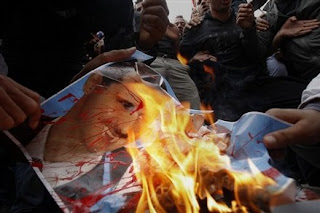
واليوم بعد عشر سنوات لم أجد شيئاً يسعدني أكثر من رؤية السوريين وهم يطالبون ببعض الحرية, بعض الكرامة, بعض المنطق في حياتهم اليومية, وأكثر ما أسعدني هو رؤيتهم يحرقون صورة بشار الأسد

عفوا.... يحرقون صورة حضرة سيادة الرئيس بشار الأسد